Unearthing the treasure chest of Big Joe Thompson
The story of one of the greatest rugby league players you've never heard of.

As the HMS Jervis Bay left the port of Southampton and set sail for the other side of the world, the 28 members of Great Britain’s rugby league touring party for the 1932 Ashes series regaled the crowd who were waving them goodbye with a repertoire of songs. There was the unofficial tour anthem of ‘England, My England’. The Welsh contingent were represented by a rendition of ‘Land Of My Fathers’. And as a newspaper report noted at the time, ‘the Yorkshiremen and Lancastrians had replied with something about the captain playing his ukulele while the ship went down.’
The players weren’t to know, but that final ditty became an unfortunate portent. During the Second World War, the HMS Jervis Bay was requisitioned by the Royal Navy and converted into an armed merchant cruiser. During an escort of 37 merchant ships from Bermuda to Britain in November 1940, an encounter with the German warship Admiral Scheer prompted the captain Edward Fegen to order the rest of the convoy to scatter while he used the Jervis Bay to attract enemy fire. Ravaged in the battle, Fegen’s actions nonetheless bought the rest of the convoy an hour’s time, allowing 32 of the 37 ships to escape. Fegen went down with the Jervis Bay, and was posthumously awarded the Victoria Cross. The Australian writer turned spy (yes, really) Michael Thwaites wrote an epic poem about the ship that begins:
This is the plain imperious story
Of an old ship that plied her trade
Obscure, and came to Hell Mouth unafraid,
And fought, and perished in a burning glory
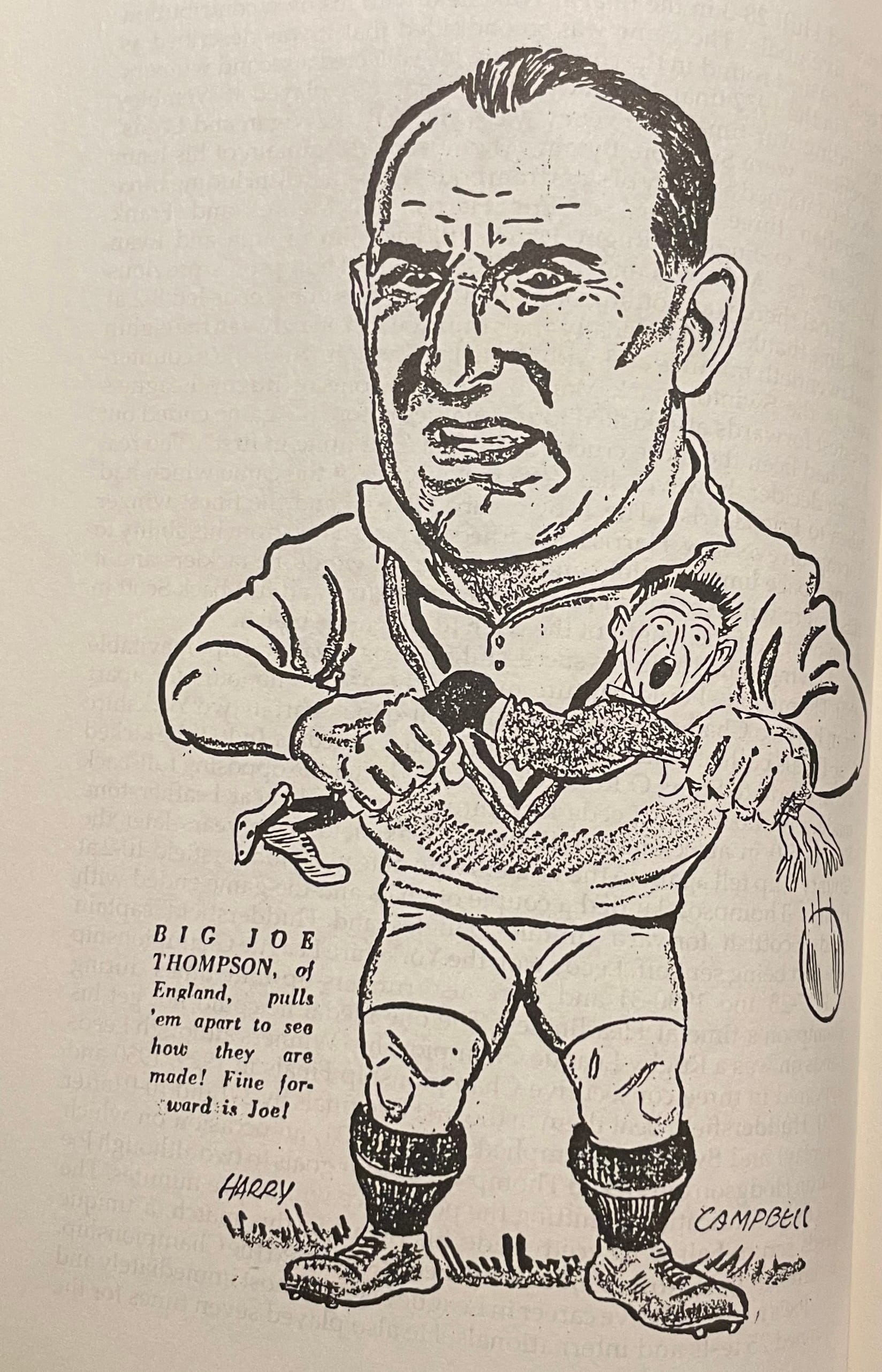
Back in 1932, the singing was led by the two most experienced members of the squad, captain Jim Sullivan, of Wigan, and Leeds forward ‘Big’ Joe Thompson. In travelling to Australia, the duo joined previous captain Jonty Parkin as the only Great Britain players to be selected for three tours Down Under, having also been a part of the triumphs in 1924 and 1928. Thompson was the first forward to complete a hat-trick of tours.
Their standing as senior players meant that while their teammates were squeezed into cabins of four, worrying about whether it was safer to be on the top or bottom bunk when journeying through the treacherously rough waters of the Bay of Biscay, Sullivan and Thompson shared a cabin between themselves.
There was only one problem. Sullivan had forgotten the team mascot. “Do you know,” he said, “the wife and I have searched all over Lancashire for a toy bulldog and have not been able to get hold of one.”
⬧⬧⬧
Joe Thompson boarded the ship carrying his belongings in a leather Victor suitcase. Almost a century later, I’m sitting on a sofa in north Leeds trying to process the contents of that very same suitcase.
Big Joe, it turns out, was something of a hoarder.
Alongside his international caps and Challenge Cup winners’ medals are newspaper clippings, shaving kits, driving licences and pension books. I’d found out about the suitcase after interviewing Thompson’s great grandson Chris Toft about his exhaustive collection of weird and wonderful Leeds United shirts for The Square Ball. Sifting through the vast array of possessions that his great grandad seemingly couldn’t bear to part with, Chris laughs. “Now I know where I get it from.”
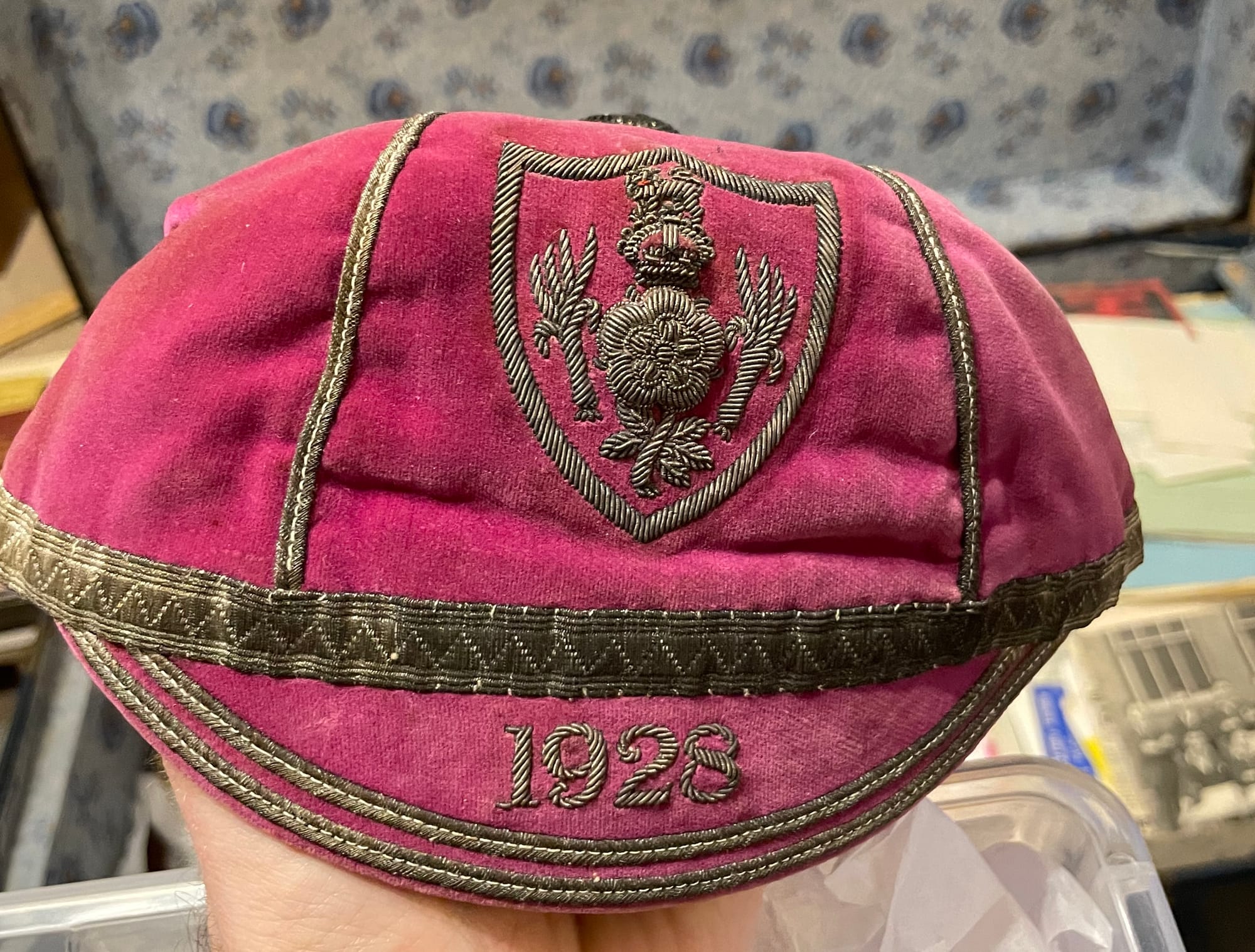
Among the lifetime’s worth of material are a number of mementos from Thompson’s tours with Great Britain. Engraved boomerangs. Maori shields. Dinner invites and menus. Photograph film negatives. A piece of rock from the foundations of the Sydney Harbour Bridge.
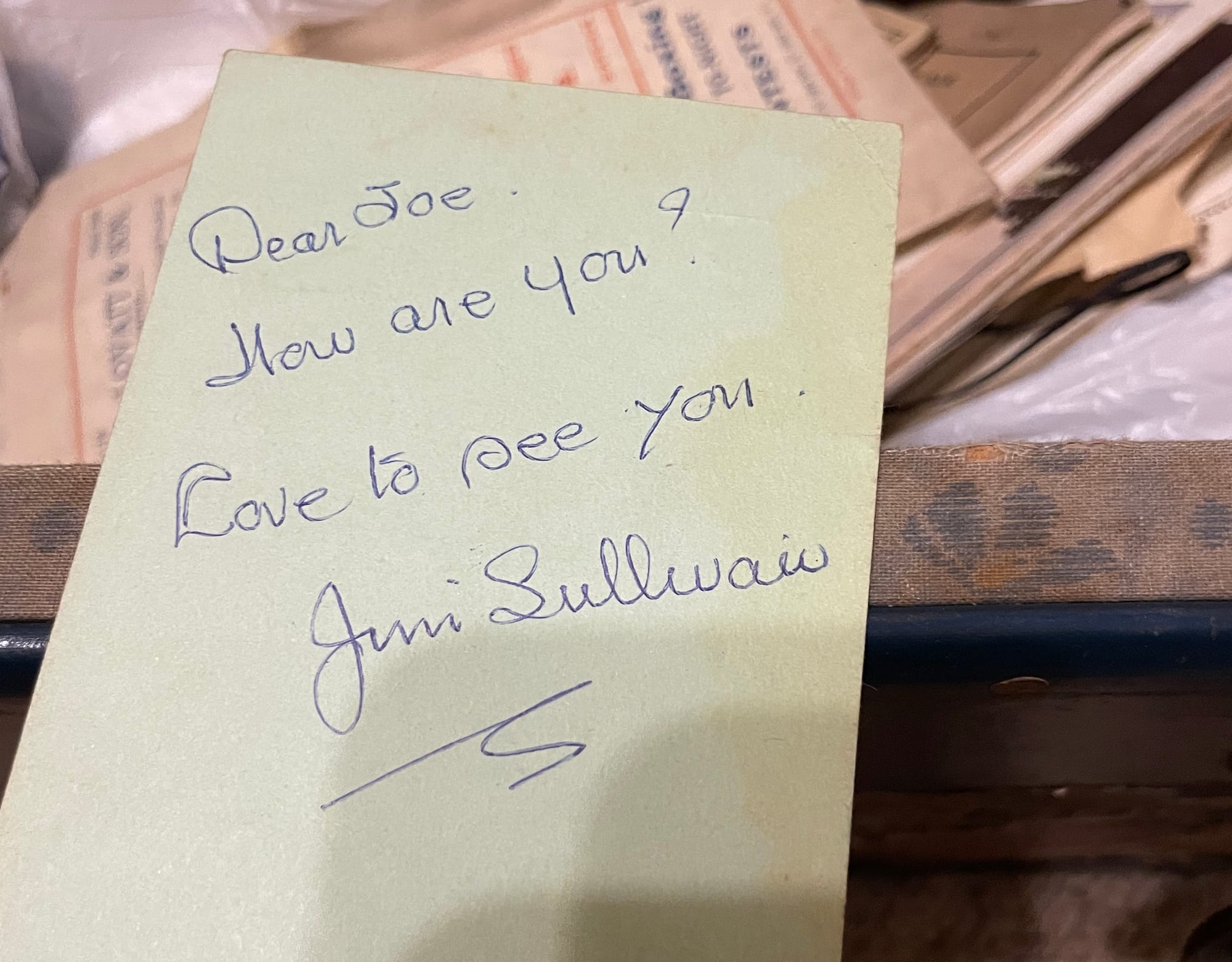
In the middle of it all is an unassuming Wigan Football Club ticket, dated 7 August 1971. On the back of the ticket is a short handwritten note from an old friend:
Dear Joe
How are you?
Love to see you
Jim Sullivan
⬧⬧⬧
The suitcase is an archive of an extraordinary life. Born in Gloucestershire, Joe Thompson was raised in Crosskeys, Wales. A keen soccer player, he started working down coal mines as a 13-year-old and didn’t even play rugby until his late teens. His talent for the game was such that by the age of 20 he was making his debut for Wales’ rugby union side in a 7-3 defeat against England at Twickenham.
During that game, Leeds scouts spotted Thompson walking to the sideline and spitting out a few broken teeth before carrying on with the rest of the match like nothing had happened. They were immediately enamoured. In ‘going north’ to sign for Leeds for £300 and switch to the thirteen-a-side code, Thompson became a pariah among the Welsh Rugby Union. He had to wait 52 years until he was presented with his cap from that day.
Initially a second row, Thompson eventually evolved into a prop forward and became renowned as the complete rugby league player. While he could more than hold his own against opposition forwards — at a time when scrums were still a notorious physical battle — he gained a reputation as an immensely skilful all-rounder with both hands and feet. He wasn’t a goalkicker when he arrived at Headingley, yet by the time he retired he’d scored 1,883 points in a Leeds shirt, a tally that only two players — Lewis Jones and Kevin Sinfield — have bettered in the club’s history.
If rugby league provided an escape from the coal mines, then the Ashes tours gave Thompson experiences he could never have imagined. During the six-week voyage to Australia, the tourists took brief stops ashore in Malta and Sri Lanka. Thompson chronicled the adventure in The Yorkshire Post, albeit given each instalment was submitted by post, they were all published a month after the events described. They read like early editions of Michael Palin’s diaries, Thompson marvelling at his surroundings and its people with an innocent curiosity while retaining a typically British dry sense of humour.
While the players were entertained by a local conjuror pulling live chickens from his pockets upon berthing to refuel at Port Said, Colombo, Big Joe preferred the scene of teammate Barney Hudson lending the magician half a crown to perform a trick, ‘and when the trick was completed and he returned the coin to Hudson it turned out to be a penny.’ Thompson also made a point of taking some of the younger players to areas away from the bustling tourist spots of the ports to show them the ‘real’ Sri Lanka and the impoverished conditions in which people were living, if only to remind them how privileged they were to be travelling the world representing their country. As for the milk, produced straight into jugs from herds of goats paraded up and down streets, ‘That’s fresh enough,’ he wrote.
When travelling on the Jervis Bay, the players woke at 6:30am so they had the deck to themselves to train for an hour, ‘and then we have a cold shower and wait for the breakfast bugle to blow.’ Simplicity was key for Thompson, who credited the fine physical condition of the squad to ‘the plain but wholesome food we have received on the Jervis Bay. On previous trips the food has been more fancy, and we are not used to that.’
A photo accompanying one of his columns showed Thompson alongside four teammates sunbathing on deck as the ship passed through the Red Sea. A committee was selected to organise games, dances and concerts throughout the journey. ‘Sullivan is to MC the dances and select the music, so we can be sure of some “red hot” numbers,’ Thompson wrote. ‘Every night after dinner we all go to the after-deck for a sing-song. We are brushing up our war cry song. We sing at all the receptions we receive at the different places we visit, and we have a nondescript orchestra — Adams plays the mouth organ and Mr Anderton the “uke”. Mr Brown, the Wigan director who is one of the party, has turned out to be a dark horse. He purchased a violin at Malta and, what’s more, he can play it. We only need Jim Brough, with his accordion, to complete the band. Heaven help the wireless sets if this trio should ever broadcast.’
⬧⬧⬧
Upon arriving in Australia, the Great Britain squad was the star attraction wherever they travelled. During a brief stop at Fremantle on the west coast, the mayor adjourned a court case he was presiding over for twenty minutes so he could officially welcome the players.
They finally stepped off the Jervis Bay for good at Melbourne, where they were given a civic reception, before moving onto Sydney. The team trained at the iconic Sydney Cricket Ground, where the pitch was so pristine that the players commented, “It seems a pity to play on it.” Yet while the tourists were wowed by their new environment, the locals were awed by the size of their visitors. Thompson overheard a spectator at a training session remark, “They are big enough to push the bridge over.”
Big Joe was appreciative of the attention the team attracted and the warm welcomes they received, even if it felt somewhat alien compared to England. ‘We may be just as excited when the Australians visit Leeds,’ he wrote, ‘but we mask our feelings.’
The tourists based themselves at a family-run Sydney hotel that became a home away from home they were always happy to return to from their travels around the country. While they had so many invites to dinners and dances and theatres they didn’t have the time to accept them all, Thompson seemed most grateful for a radio they had been gifted for their headquarters, regularly mentioning the treasured wireless in his tour diaries. ‘No better host and hostess than Mr and Mrs Masafont could be found in all Australia. In our hotel we are just like one big family.’
Two of Britain’s first three tour matches were played at the SCG, leading into the First Test at the same arena. On their only trip away in that time, they faced Western New South Wales in the gold-mining town of Orange.
'The journey was made by road, leaving Sydney the day before. It was a very interesting drive, through the towns of Katoomba, Lithgow, and Bathurst, and through the Blue Mountains. It was very lovely scenery.
'We were met at Lucknow, five miles from Orange, by the leading citizens, who explained to us that Lucknow was the richest gold mine in the world. The Mayor of Orange, Alderman Blowse, who tended us the welcome, pointing to some heaps of dirt scattered about, told our lads that over £16,000,000 worth of gold had been taken from the ground where they stood.
'He also told them how in olden days people used to dig up a bucket full of earth and get a billy-can full of gold. At this, Adams, who is always ready with some smart remark, approached him, and asked: “Have you got a bucket and spade handy?”
⬧⬧⬧
After winning their first three tour matches, Thompson ran out at the Sydney Cricket Ground for the First Test against Australia and was greeted by ‘a vast kaleidoscope of humanity’. The 70,000 crowd in attendance set a new rugby league world record for a Test match, with thousands more locked outside.
To mark the sport’s silver jubilee in Australia, it was agreed for the game to be kicked off by the legendary Dally Messenger, even though it was almost twenty years since he last played rugby league. Despite falling behind, Britain came back to win 8-6, although Thompson admitted the game was not a classic, ‘it was too keen for that’.
'We won this, our first Test, after a terrific struggle. It was a grimly fought match, and was no game for weaklings — a game where no quarter was asked nor given, a game where the tackling was murderous, and if a man was caught with the ball, he knew about it.'
The players had no time to celebrate their triumph, immediately leaving Sydney that evening and on to Queensland. After beating Far Northern on the way, Thompson was named captain in the absence of Jim Sullivan for a fixture against a Queensland side that had beaten Great Britain on their previous two tours.
It was a landmark occasion for Thompson, not for skippering the side, but because it became the first time in his career that he could not finish a game due to injury. The incident happened only minutes into the match, as Thompson was on the end of a sickening kick to the head. While there were fears he might have fractured his skull, someone evidently assumed that if Big Joe Thompson had to be taken off the field, there was only one plausible explanation: a telegram was sent to his wife Ivy back in Leeds informing her that her husband had passed away.
How that happened or whether Thompson was even aware it had is unclear. In his diary entry from the time he explains he simply suffered 'severe concussion' and was back in training two days later. 'I am pleased to say that, at the time of writing, I am just about all right again. It was a great win, considering we were only playing with twelve men. I was told afterwards that the twelve played like heroes.'
But talk of his demise evidently spread quickly back in Leeds. Three days after the Queensland game, a reporter going only by the byline ‘Northern’, wrote in the Yorkshire Post about a bizarre encounter with two concerned strangers while walking home late one night:
'Out of the shadows of a side-street stepped a man. “What’s the news of Joe Thompson?” he said. I stopped uneasily. What was the news of Joe Thompson? And who was this sinister stranger, anyway?
'Another man — an accomplice, evidently— closed in on us. Only one thing remained — I must humour them. “Ah, old Joe...” I began. “Aye, how is ’e?” said the second man hoarsely. “He seemed very well when I saw him last,” I ventured.
'“That’s what I thought,” said No 1. “He shouldn’t ever have gone to Australia.” “Aye,” muttered No 2 in sombre agreement. Australia, I gathered, was no longer the place it used to be for fugitives from justice.
'“You being on the Post,’” resumed the first man, “you ought to know how he is. There’s been stories about that he’s dead. I know you’re on the Post, because I’ve seen your face before.”
'Then I realised. “Oh, you mean Joe Thompson,” I cried. “ Aye, Joe Thompson.” And I was glad to tell them that Joe Thompson, the Leeds forward, had made a rapid recovery from concussion out at Brisbane.'
As a result of his injury, Thompson missed the next game as Britain slipped up for the first time on tour, losing narrowly 18-15 to Brisbane Firsts. He at least got to enjoy the post-match invite to Brisbane Junior Rugby League’s boxing and wrestling tournament, where any players who had been sent off on the pitch for fighting that week were given the opportunity to settle their differences in the ring. ‘This is a tip for the officials at the Leeds boxing halls,’ he wrote. ‘If they take it up they will be able to put on bouts every night, instead of every weekend.’
Thompson was back in the team three days later for the Second Test at Brisbane Cricket Ground. Australia won 15-6 in a game that has gone down in infamy as ‘The Battle of Brisbane’. Fans began queuing outside the stadium at 9am, and by 12:15pm ‘it did not seem possible to get a fly into the ground’. Although Thompson was stunned by the sight of supporters climbing the roof both of the stadium and the surrounding houses, he was full of disdain for the eighty minutes on the pitch.
'There is no doubt whatever that this second Test of the 1932 tour will go down as the roughest and toughest match in the history of the game — a game full of incidents that are best forgotten.
...
'I should imagine that never before has such a fierce encounter been seen and it is to be sincerely hoped it will be the last. While there was a great deal in this game one could find fault with, the one redeeming feature was the courages spirit shown by the victors and the vanquished. After all, the game is for virile men, and these Test matches have always been noted for the grimness of the play, and the deadliness of the tackling.'
For all Thompson used his diaries to bemoan the standard of refereeing Down Under — ‘I should like to say that the weakest of our referees at home is a Mussolini compared with the officials here’ — it sounded an awful lot like the Great Britain team had given as good as they got:
'To give you some idea of the keenness of this game, here are a few of the injuries — Australians: Dempsey broken arm; Weissel, broken bone in foot; Gee, four stitches in lip; O’Connor, stitches over eye. Englishmen: Adams, torn thigh muscle; Hortson and Feetham, injured knees.
'I have just mentioned the worst. There was not a man left the field without bearing the brunt of the fray, owing to coming in contact with either the hard ground or somebody’s fist.'
⬧⬧⬧
After so much excitement and joy at the start of the trip, a taste of the travails of touring life only seemed to inspire the Great Britain side. Thompson’s writing immediately became more vivid, without losing his sense of humour:
'We left Brisbane the Sunday following our second Test match for our tour of North Queensland. It is from now on that the fellows who are making their first trip will realise that they really are on tour.
'Up to present we have been domiciled in one hotel, but now we are in the train one night, then in a hotel, and then off again.
'We are rolling stones with a vengeance. We certainly do not gather any moss, but we all need a shave when we alight from the train. Most of us are afraid the shave might be too close if we risk it while the train is in motion, for the vehicles here are not so well sprung as they might be.'
The playing fields were becoming so hard that one player exclaimed, “By gum, it’s concrete with whiskers on.” On the way to their game against Central Queensland in Rockhampton, the team was stopped due to a fire at the New Theatre across the road from their hotel. They were meant to be attending a dance at the venue after the game, prompting Castleford centre Arthur Atkinson to ask, “Do you think all the food is burned?”
There was almost a month between the second and third Tests, in which Britain played eight games and won seven, drawing the other 7-7 with Toowoomba. In their final tour match before the Ashes decider back in Sydney, Great Britain beat Newcastle 32-15 in farcical circumstances. The timekeeper rang the full-time bell ten minutes before the game was supposed to finish. The players had returned to the changing rooms and supporters had swarmed the pitch before the mistake was realised. It took another ten minutes to clear the crowd from the field and restart the game. 'Then, to make a good job of it, we finished up playing five minutes over time.'
The game was also notable for being the first time Thompson had ever been sent off. Reports agreed with Thompson that it was a mystifying decision, pointing out that every time Great Britain had played at Newcastle they’d had a player red carded. It did little to assuage Thompson’s concerns about the officiating, particularly after the unpunished violence in The Battle of Brisbane.
'Thinking over my dismissal,' he wrote, 'I have come to the conclusion that the touch judges in the second Test match were Yorkshiremen — you know, the kind who “see all and say nowt”.'
⬧⬧⬧
In the build up to the final Test match against Australia, back at the SCG, Thompson described the anticipation to ‘the feeling of sitting on a keg of gunpowder and expecting it to blow up any minute — as we walked in from the members’ stand, on our way to the dressing room, the air seemed to be charged with electricity’.
Like in Brisbane, supporters were queuing outside from the early morning to guarantee entry. To entertain the early arrivals, warm up matches were played on the pitch, starting at 10am and building up to the big kick off. 'When these people had seen the Test they would have watched seven hours of football,' wrote Thompson. 'They must like it.'
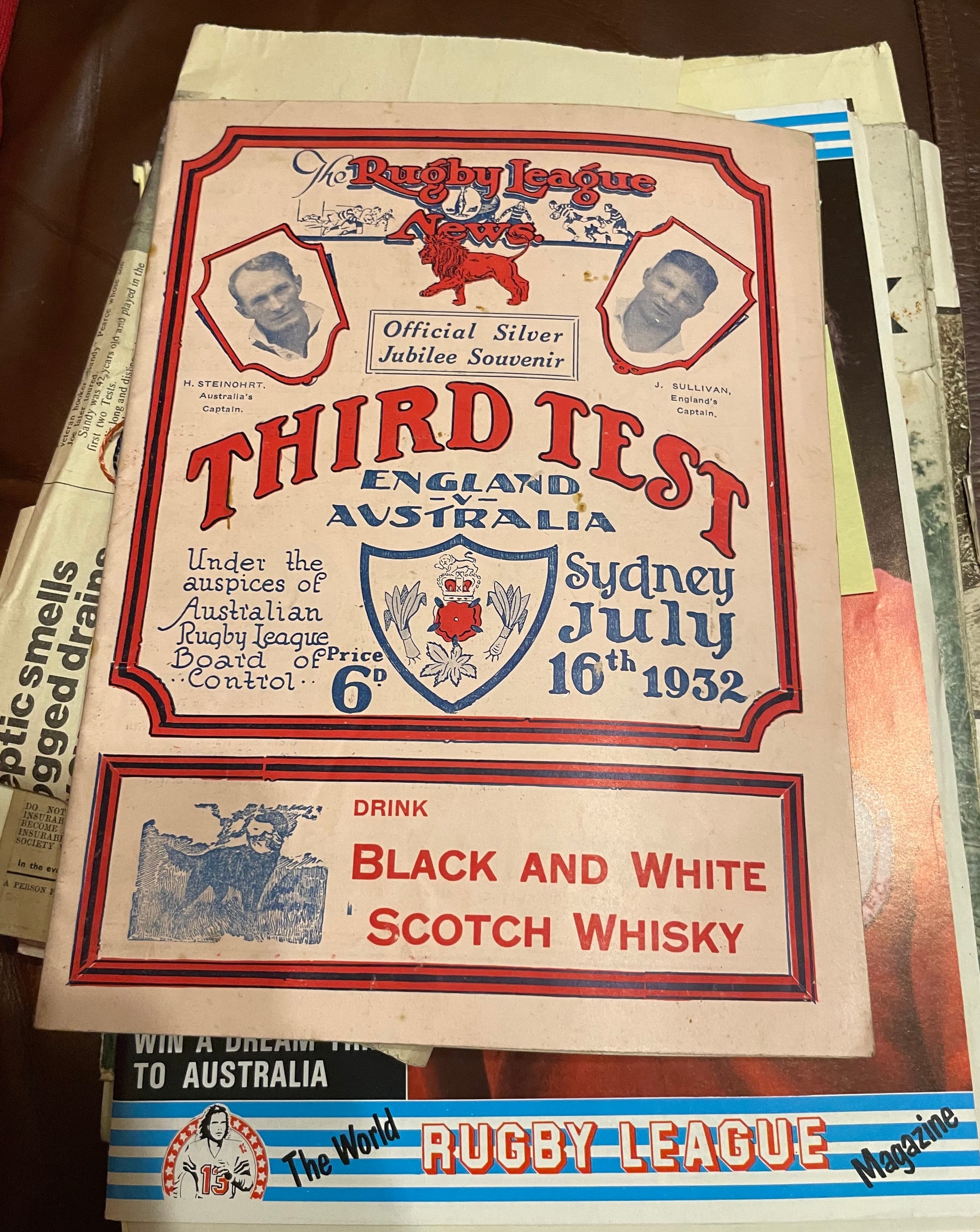
Before the players left the changing rooms, team manager Hutchins borrowed a line from Lord Nelson ahead of the Battle of Trafalgar. “England expects.”
In a back and forth game, Great Britain eventually clinched the series with a 18-13 win. Thompson was as relieved to banish the skullduggery of Brisbane as he was to win the Ashes. 'What a game!' he wrote. 'All the shocking “rough stuff” evident in the second Test was cut out, both teams playing the game as it should be played and with the score fluctuating as it did, it sent the huge crowd frantic with excitement.'
Ultimately, Thompson reflected on the 'biggest and brightest' Ashes series to date.
'The First Test will be remembered for the record gate that it drew, the Second as the roughest and toughest Test ever played, and the Third as the most vital and exciting Test ever played on the historic Sydney Cricket Ground.'
⬧⬧⬧
The Ashes might have been won, but the tour was not over. Before long they were leaving Australia for New Zealand, where Great Britain won a further eight games in the space of a month, including all three Test matches against the Kiwis.
Thompson wrote glowingly about the time he spent experiencing Maori culture in a settlement in Rotorua, disappointed he didn’t have more time to 'sit all night and listen to their beautiful singing and watch their quaint dances'.
After the opulence of the Sydney Cricket Ground, the players got changed before one game in a butter factory due to a power cut because of extreme weather, before the match itself was played without a barrier separating spectators from the field, meaning players had to run around fans to dot the ball down for a try or dive for the line among their feet.
There was, however, a note of homesickness in Thompson’s diaries after the squad left Auckland for Christchurch.
'On arriving at South Island we encountered winter as we know it in England. They had had a recent fall of snow, and I can assure you it made us think of home when we landed among such surroundings.'
Four months after leaving England, the players eventually returned to Southampton in September. While some of the players immediately rushed north to take part in club games later than afternoon, Thompson had the luxury of being able to take his time, regaling supporters and journalists with tales of spotting alligators as they travelled home through the Panama canal and showing them the souvenirs he’d brought back stuffed in his Victor suitcase.
As for the actual rugby, a reporter noted:
'The first Test match, because of the tremendous crowd, and the third Test match because of its fine football, are among the happiest of the tourists’ memories of Australia. When you talk to them about the second Test at Brisbane they chuckle when they say that all the members of the two sides were short of were revolvers, and then they turn to another subject with the remark that the least said about that second Test the sooner mended.
'They would rather talk of the last five days on the Tamaroa [ship]— and they were fierce days with the ship battling against a storm which compelled all the passengers to keep below decks, and with the gale one night striking the ship to send Joe Thompson, Adams, their chairs, and their dining table across the floor of the saloon — than the second Test.'
⬧⬧⬧
Almost exactly a year after the final tour match, Joe Thompson shocked the rugby league world by announcing his retirement. Hailed as 'one of the greatest players and finest sportsmen the code has known', Thompson had begun pre-season training with Leeds only to be offered a job with the Leeds Tramways Department that required him working nights.
“I have played international football from my first to my last season,” he said, “and I want to retire at such a time, not by gradually ‘fading’ out of the game with lesser clubs than Leeds.”
A report on his retirement dubbed Thompson, 'the only rugby league player to have been rumoured as dead and to be still alive', while Big Joe himself still hadn’t gotten over the brutality of the Battle of Brisbane.
“It is very easy for me to pick the worst game I ever played in. That was the second Test at Brisbane against the Australians last year. It was nothing but savagery, and every man was lucky to get out of that game alive, never mind anything else.”
Leeds quickly made Thompson only the second life member of the club after Lady Airey. He remained involved at Headingley as a coach, helping to teach Jean Galia’s trailblazing France team the basics of rugby league ahead of their first ever games in a six-match tour of England in 1934.
Too old to fight in World War Two, Thompson instead spent four years in the police force as a war reserve constable, working alongside Leeds hooker Con Murphy, another Welsh convert from Crosskeys, and often joking that together they “cleaned the city up”.
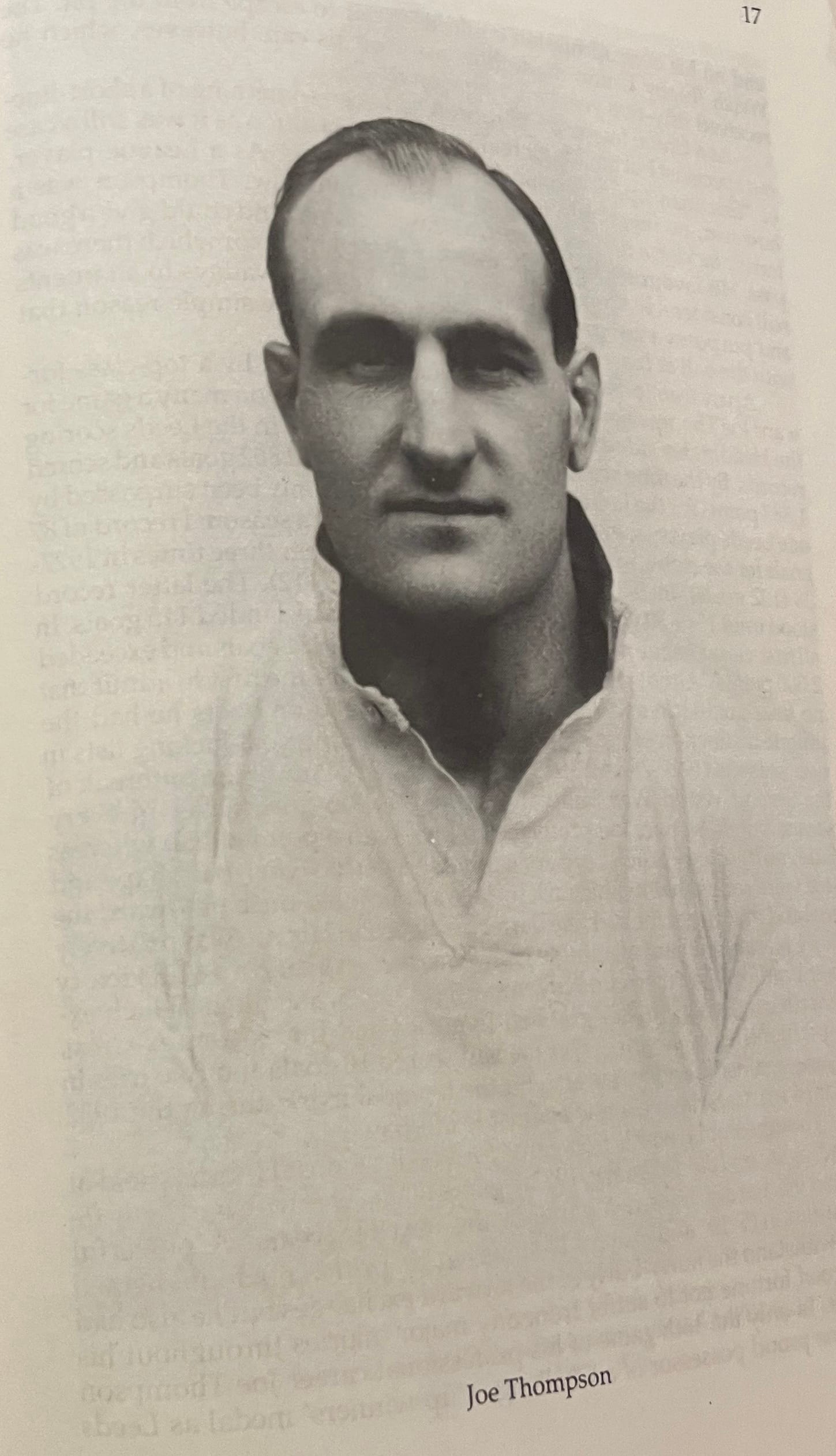
Thompson’s granddaughter Glenys remembers Big Joe as a gentle giant. “He really enjoyed writing,” she says of his tour diaries. Glenys was brought up in Thompson’s home after her mother passed away when she was still a child. He didn’t smoke or drink and got his pleasure from singing in the choir at St Stephen’s Church in Kirkstall, only a stone’s throw away from Headingley stadium, or simply walking his dog, even if a short walk could take him an hour due to being stopped by so many strangers who knew him either as a rugby player or the local policeman. Indeed, Thompson doesn’t appear in any of the photos from Glenys’ wedding day because he’d left to take his dog out.
After searching through the contents of his suitcase, Glenys proudly shows me a number of books that mention Thompson’s life and career, becoming tearful when reading back the description of her grandad as ‘almost as much a part of the Kirkstall scene as the old abbey itself’.
Another ends with the words of The Yorkshire Post’s rugby league correspondent Alfred Drewery from a 1951 edition of 'Rugby League Review':
'Never was there a man less likely to have his head turned by fame or flattery. His approach to life was like his approach to football — simple, direct, thoughtful and sincere. There was something reassuringly solid about that massive figure, that firmly moulded beak of a nose and that determined, jutting jaw, its severity relieved by the bald patch which gave him an air almost scholarly. Joe Thompson was dependability itself.' ⬧